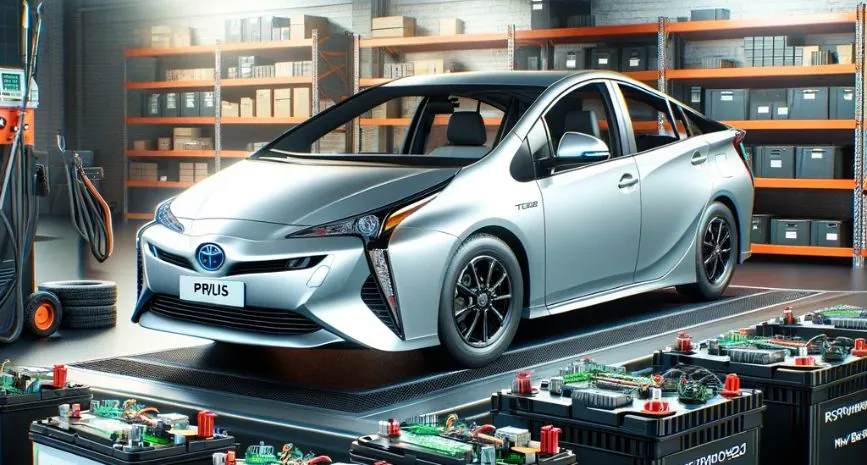
In the landscape of automotive maintenance, few procedures reveal our complex relationship with technology more clearly than Toyota hybrid battery replacement—when the hidden power source suddenly announces its mortality through warning lights and diminished performance. Its failure forces a reckoning with the boundaries of our technical understanding and our position as users of systems we depend upon but rarely comprehend.
The Silent Partner in Mobility
What we call a hybrid battery represents an intricate energy management system—a collection of cells, cooling mechanisms, control boards, and sensors that perform the complex dance of capturing, storing, and deploying electricity. Key components include:
- High-voltage cell arrays (NiMH or lithium-ion)
- Thermal management systems to prevent overheating
- Electronic control units managing charge/discharge cycles
- Cell balancing circuits ensuring even energy distribution
“Most Toyota hybrid owners experience eight to ten years of reliable service before battery issues emerge,” explains Ms. Tan from Green Vehicle Specialists Singapore. “But this timeline varies based on driving patterns, climate conditions, and maintenance history.”
The evolution of Toyota’s hybrid battery technology tells a story of incremental refinement. The first-generation Prius utilized relatively primitive NiMH cells that, while revolutionary for their time, had limitations in energy density and thermal management. Each subsequent generation has introduced significant improvements in reliability and performance.
The Art of Battery Diagnostics
Between the warning light and replacement decision lies the sophisticated world of hybrid battery diagnostics. Common methods include:
- Cell-by-cell voltage mapping to identify underperforming units
- Thermal imaging to detect hot spots and cooling issues
- Load testing under simulated driving conditions
“Each battery has its own unique fingerprint of degradation,” explains Dr. Hiroshi Nakamura, a Toyota hybrid systems specialist. “Using thermal imaging and voltage mapping, we can detect patterns that tell us which cells are underperforming and why.”
This forensic approach has spawned specialists equipped with proprietary diagnostic tools. “It becomes almost like reading a patient’s medical chart,” says Farah Zulkifli, who operates a specialized hybrid service center. “I can look at voltage patterns and immediately recognize certain driving habits that accelerate degradation.”
The Economics of Power and Renewal
There’s something revealing about our response to major repair costs—the calculations that occur when a central component requires significant investment. These moments force a reckoning with questions of value and longevity.
The considerations typically include:
- Vehicle value weighed against replacement cost
- Environmental implications of repair versus replacement
- Expected additional lifespan gained through renewal
- Regional factors affecting battery performance and longevity
- Warranty considerations and dealership relationships
“What many Toyota owners don’t realize is that hybrid battery replacement isn’t necessarily an all-or-nothing proposition,” notes Mr. Lim from Hybrid Solutions. “Cell-level diagnostics often reveal that only specific modules have degraded.”

The rise of hybrid-specific service centers represents a significant shift in the automotive maintenance landscape. These specialized facilities have developed proprietary techniques and equipment specifically calibrated for Toyota’s hybrid systems. Some even offer “battery subscriptions”—a novel approach where customers pay monthly fees for guaranteed battery performance rather than one-time replacement costs.
Beyond Repair: The Afterlife of Energy Systems
What happens to hybrid batteries after removal reveals important truths about our waste management systems. These power sources begin new journeys invisible to their former owners.
“The most progressive approach involves creating second and third lives for Toyota battery components,” explains Dr. Wong from the Centre for Sustainable Technology. “Cells that can no longer meet vehicle demands might serve perfectly well for home energy storage.”
The reclamation process categorizes cells by remaining capacity. Those retaining 80% or more can be reconfigured for less demanding applications. Cells between 50-80% typically find purpose in stationary storage systems. Even heavily degraded cells contain valuable materials—particularly cobalt, nickel, and lithium—that specialized facilities can extract for reuse.
Singapore has emerged as a regional hub for hybrid battery recycling, with advanced facilities capable of processing thousands of units monthly. This infrastructure supports a circular economy approach that maximizes resource efficiency and minimizes environmental impact—a model being studied by other countries in the region.
The Future of Powered Mobility
As Toyota’s hybrid technology evolves, our relationship with these power sources will change. Emerging capabilities include:
- Vehicle-to-grid functionality returning power to the electrical grid
- Self-diagnostic systems predicting failure before it occurs
- Integration with home solar and energy storage systems
- Modular designs simplifying maintenance
“We’re moving toward vehicles that don’t merely contain batteries but function as mobile energy nodes,” observes Ms. Chen from Future Transport Solutions.
Perhaps most intriguing is Toyota’s research into self-healing battery technology. Drawing inspiration from biological systems, these experimental cells incorporate compounds that automatically deploy to repair degraded connections.
“The ultimate goal is batteries that maintain themselves much like living tissues,” explains Dr. Yamamoto, principal researcher at Toyota’s Advanced Energy Laboratory. “Rather than degrading linearly, these systems would maintain performance through constant regeneration.”
When your Toyota displays those battery warning signs, remember that your decision involves not just a repair but participation in evolving systems of energy and materials—systems made momentarily visible through Toyota hybrid battery replacement.