Large-scale farming operates on a different set of demands from smallholder or mixed farming. The fields are bigger, the implements are heavier, the operational windows are tighter, and the cost of a single day of downtime during peak season ripples across a much larger area of crop. In this context, the choice of tractor is not simply an equipment decision. It is a business decision with direct implications for the profitability and sustainability of the entire farming operation.
For large-scale farmers, high horsepower tractors are not a luxury. They are the practical answer to a set of operational demands that lower-powered machines simply cannot meet.
The Physics of Large-Scale Field Operations
Primary tillage across large acreages requires significant drawbar pull sustained over long periods. A tractor working a wide-cut plough or heavy disc harrow through compacted or heavy soil needs to maintain consistent power delivery without the engine labouring, overheating, or losing ground speed as field conditions change.
High horsepower tractors are engineered for exactly this type of sustained, heavy-duty output. Their engines are designed to produce strong torque across a broad operating range, which means they maintain pulling power and field speed even when resistance increases. For large-scale operations where consistency across hundreds of acres in a single working period matters, this characteristic is fundamental.
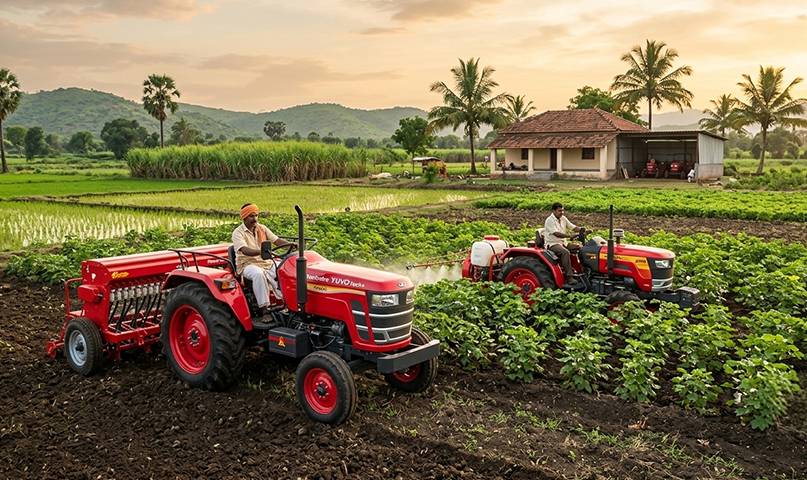
Powerful farming tractors in the higher HP segments also support wider implements, meaning more ground is covered per pass and the same acreage is completed in fewer field hours. In operations where time during the planting or harvesting window is the binding constraint, the productivity advantage of a wider, faster machine is directly measurable in the final yield.
Agricultural Mechanization at Scale
Agricultural mechanization reaches its fullest expression in large-scale farming operations where high-performance equipment is matched to large, productive acreages. A high horsepower tractor connected to a precision planter, a wide-cut harvesting header, or a large-capacity sprayer is not simply doing the same job as a smaller machine more slowly. It is enabling a fundamentally different level of operational efficiency that transforms what is possible within a given season.
The ability to prepare, plant, manage, and harvest large areas of crop within the optimal agronomic window for each operation is what separates high-performing large-scale farms from those that consistently leave yield on the table because operations run over time. Agricultural mechanization at this level requires equipment that is engineered for the scale of the task, and high horsepower agricultural tractors are central to that capability.
Durability Under Sustained Pressure
High-HP tractors in serious large-scale farming do not work occasional long days. They work relentless long days, across weeks and months of sustained, demanding operation. The durability of every major system, from the engine and transmission to the hydraulics, axles, and linkage components, is tested continuously in a way that has no equivalent in lighter-duty farming applications.
The agricultural tractors that earn a lasting reputation in large-scale farming markets are those built with the component quality, manufacturing precision, and design engineering to sustain this level of demand across thousands of operating hours without compromising reliability or performance. Farmers managing large operations have neither the tolerance nor the operational flexibility for machines that begin to show weakness under sustained pressure.
Durability in a high-HP tractor is not a single feature. It is the cumulative result of engineering decisions made across every system in the machine, and it is ultimately validated not in a testing facility but across seasons of real-world fieldwork.
Smart Farming Solutions for Large-Scale Efficiency
The most productive large-scale farming operations today are those that combine high horsepower tractors with smart farming solutions that optimise how that power is deployed. GPS-guided precision steering eliminates the pass-to-pass variability that costs seed, fertiliser, and fuel across large field areas. Telematics systems monitor machine performance and alert operators and fleet managers to maintenance requirements before they become operational problems.
Variable rate technology, precision depth control, and intelligent implement management allow the tractor and its attached equipment to respond dynamically to changing field conditions rather than operating at a single fixed setting across the entire field. For large-scale farmers managing diverse soil types, slopes, and crop zones within a single property, this adaptability has a direct positive effect on input efficiency and yield consistency.
An Investment That Performs Across Seasons
A high horsepower tractor represents a significant capital investment, and in large-scale farming, the return on that investment is measured in seasons of reliable, productive operation rather than in months. The machine that performs consistently from the first day of the season to the last, that responds to servicing and keeps its reliability through years of demanding work, is the one that justifies its cost and contributes to the long-term commercial health of the farming operation.
For large-scale farmers serious about building a productive, efficient, and resilient agricultural business, powerful farming tractors with the durability, horsepower, and smart technology to match the scale of their ambition are not optional equipment. They are the foundation the operation is built on.